How to Improve Your Local SEO in 2026: Proven Ways to Rank Higher Locally
Local search has never been more competitive. With more businesses investing in local SEO and Google continually expanding its local search features, the gap between optimized and unoptimized listings keeps growing. Businesses that appear in the local pack capture the majority of clicks for high-intent searches - the ones where someone is ready to call, visit, or buy.
This guide covers the most effective ways to improve local SEO in 2026 - from foundational optimizations every business needs to the AI-powered tools that compress the time it takes to see results.
Quick Answer
The most effective ways to improve your local SEO in 2026 are: optimize your Google Business Profile completely, build and clean up local citations, generate and respond to customer reviews consistently, create location-specific content, earn local backlinks, and use AI tools to identify and fix profile gaps continuously. These actions strengthen the relevance, distance, and prominence signals that Google uses to rank local results.
What Local SEO Rankings Actually Depend On
Google evaluates local listings across three dimensions:
- Relevance: How well your profile and content match the searcher's query
- Distance: How close your location is to the searcher or the location specified in the query
- Prominence: How well-known and trusted your business appears - based on reviews, citations, links, and profile activity
Improving your local SEO means strengthening signals across all three categories. Most businesses underinvest in prominence - the factor with the most room for improvement and the most durable ranking impact.
Ways to Improve Your Local SEO in 2026
1. Optimize Your Google Business Profile Completely
Your Google Business Profile (GBP) is the single most important local SEO asset you directly control. An incomplete or inconsistent profile limits how often Google shows your listing, regardless of how strong your other signals are.
High-impact optimizations:
- Select the most specific primary category available for your business type
- Add all relevant secondary categories
- Write a business description that includes your primary services and city naturally
- Upload new photos regularly - active profiles receive better visibility than static ones
- Keep hours accurate, including holiday hours and special hours
- Add individual services and products with descriptions
Most businesses complete their GBP once and never revisit it. Google adds new profile fields regularly - quarterly profile audits catch optimization gaps that competitors miss.
2. Build and Clean Up Local Citations
A local citation is any online mention of your business name, address, and phone number (NAP). Consistent NAP data across directories, data aggregators, and industry sites signals to Google that your business information is trustworthy.
Two priorities apply equally:
- Build citations on major data aggregators and relevant industry directories
- Fix inconsistencies - mismatched addresses, outdated phone numbers, and duplicate listings create conflicting signals that suppress rankings
Adding new citations before auditing existing ones compounds the problem. Audit first, then build.
3. Generate More Reviews and Respond to Every One
Review signals affect local rankings directly. Volume, recency, platform diversity, and owner response rate all feed into Google's prominence evaluation.
- Ask for reviews at the moment of highest customer satisfaction - immediately after a completed service or successful purchase
- Make the review link frictionless - a short URL or QR code reduces drop-off
- Respond to every review, positive and negative, within 48 hours
- Keep responses professional and consistent in tone
Responding to reviews is not only a ranking signal - it is visible to every potential customer who reads your profile. A thoughtful response to a negative review often converts skeptical readers better than a string of five-star reviews with no owner engagement. For businesses managing multiple locations, local SEO review software automates response workflows at scale.
4. Create Location-Specific Content
Content that explicitly references your service areas, local landmarks, and neighborhoods builds geographic relevance signals that generic content cannot. Location-specific content that works:
- Service area pages for each city or neighborhood you serve
- Blog posts answering locally-relevant questions your customers actually search
- Case studies referencing local clients and outcomes
- Community involvement posts that establish local presence
Each piece of location-specific content creates an additional entry point for local queries that broader content misses entirely.
5. Earn Local Backlinks
Links from locally-relevant websites signal both prominence and geographic relevance simultaneously. Local link-building focuses on sources a non-local competitor cannot easily replicate:
- Local business associations and chambers of commerce
- Local news sites and community blogs
- Sponsorships of local events, sports teams, or charities
- Partnerships and cross-promotions with complementary local businesses
A link from a local newspaper or business association carries more local ranking weight than a generic directory link with higher domain authority.
6. Optimize for "Near Me" and Voice Searches
"Near me" searches have grown consistently year over year and now extend beyond mobile - voice search and smart home devices generate significant local search volume. Optimizing for these queries requires:
- Accurate, complete GBP location data (the foundation of all proximity signals)
- Naturally including "in [city]" and "near [neighborhood]" phrases in website content
- A mobile-optimized website that passes Core Web Vitals thresholds
- LocalBusiness schema markup on your website's contact and location pages
7. Use AI Tools to Identify and Fix Profile Gaps
Manual local SEO audits miss gaps that accumulate over time - outdated category selections, missing service listings, photos that stopped being updated, review response rates that have fallen. AI-powered local SEO tools continuously monitor your profile against optimization benchmarks and surface specific, prioritized fixes.
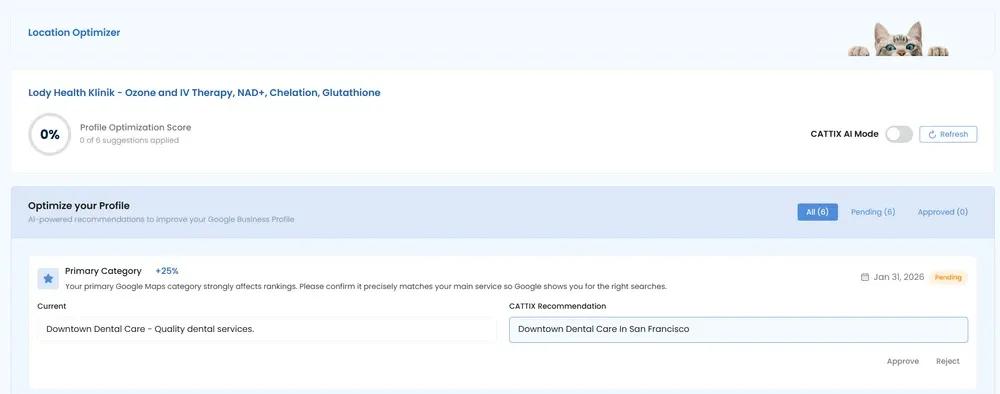
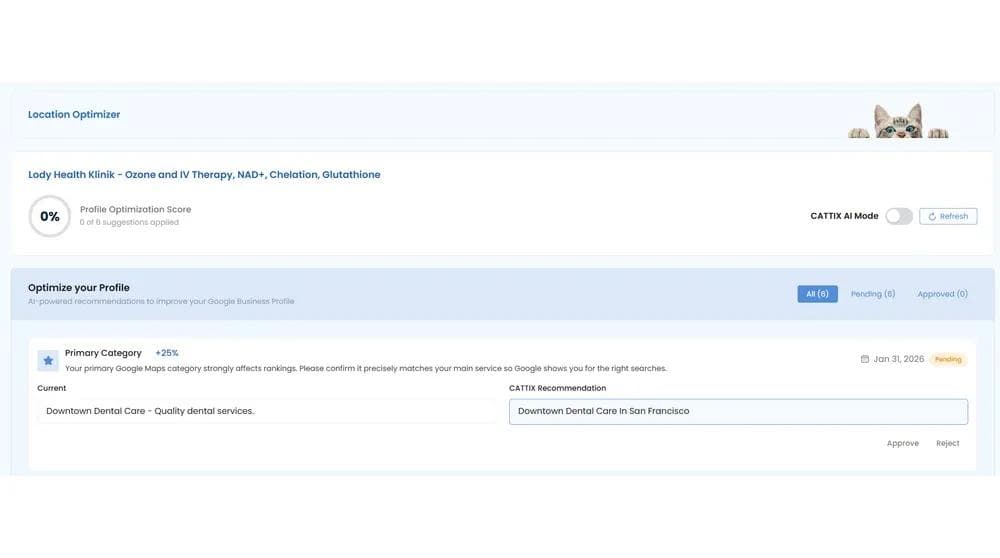
CATTIX's Location Optimizer analyzes your Google Business Profile and generates a ranked recommendation queue - specific actions ordered by their likely impact on local search visibility. Instead of a generic how to improve local SEO checklist, you see which specific improvements apply to your profile right now. For teams managing multiple locations, this replaces hours of manual profile review with a structured action list that updates continuously.
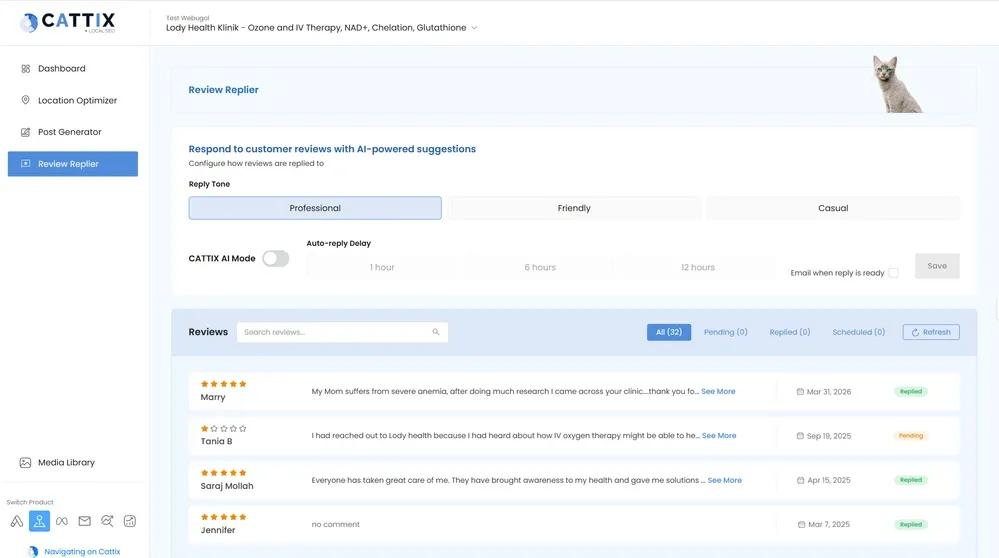
The Post Generator maintains consistent GBP posting activity automatically, and the Review Replier ensures every customer review receives a timely, on-brand response - both activities that Google counts as engagement signals in local ranking. Learn more in our guide to automated local SEO.
8. Audit Your Website for Local SEO Signals
Your GBP optimization works alongside your website, not independently. Website factors that directly affect local rankings:
- NAP consistency - your name, address, and phone must match your GBP exactly
- LocalBusiness schema markup on your contact and location pages
- Location keywords in page titles, H1 headings, and meta descriptions
- Fast mobile load times (Google uses mobile-first indexing for local results)
- An embedded Google Map on your contact page
A local SEO audit that covers both your GBP and website together identifies compounding issues that individual checks miss. Local SEO management software that handles both layers is more efficient than running separate audits for each.
Common Mistakes That Limit Local Rankings
- Selecting a broad primary category: Choosing "Restaurant" instead of "Italian Restaurant" reduces how often you appear for the specific searches most relevant to your business.
- Ignoring review responses: Low response rates are visible to Google and to every customer reading your profile. Both penalize you.
- Building citations without auditing first: Adding citations while inconsistent ones already exist makes conflicting NAP signals worse, not better.
- Treating local SEO as a one-time setup: Profile optimization degrades as competitors improve and Google introduces new profile fields. Ongoing attention is required.
- Missing location-specific content: Generic industry content that does not reference specific service areas misses the geographic relevance signals that local pack rankings require.
Conclusion
The most effective ways to improve your local SEO in 2026 combine foundational profile optimization with consistent ongoing activity - reviews, content, citations, and responses. No single tactic dominates; the businesses that rank consistently are the ones maintaining all signals together.
CATTIX's local SEO platform handles profile optimization, review management, and posting activity in one place - so your team spends time on strategy rather than manual profile maintenance. Start improving your local visibility at CATTIX.
About the Author
Eugene Ugolkov, CEO and Founder at CATTIX
Eugene is the founder of CATTIX, an AI-powered Google Ads management platform. With extensive experience in digital marketing and machine learning, he leads the development of intelligent advertising solutions that help businesses maximize their ROI.
Publications: Google Scholar