AI-Driven Local SEO vs Traditional SEO: Which Approach Gets Better Results
The question is not whether AI-driven or traditional local SEO is better in theory - it is which approach produces better results for your specific situation: your team size, number of locations, available time, and competitive environment. Both approaches can work. The difference is how consistently they work, how much effort they require, and how quickly they respond when something changes.
This guide compares AI-driven local SEO vs traditional SEO approaches across the dimensions that matter most - speed, consistency, depth, and scalability - so you can make an informed decision about which approach fits your business.
Quick Answer
AI-driven local SEO outperforms traditional local SEO on consistency, scalability, and audit depth. Traditional local SEO can match AI-driven results at a single location when a skilled practitioner applies it consistently - but that consistency is difficult to maintain and impossible to scale without AI tools. For most businesses managing more than one location, or any business where local SEO tasks are competing with other priorities, AI-driven approaches produce better results more reliably.
What Is Traditional Local SEO?
Traditional local SEO - sometimes called manual or DIY local SEO - relies on human-led processes to manage the signals that influence local search rankings:
- Manually reviewing and updating the Google Business Profile periodically
- Researching competitor profiles to identify category and service gaps
- Writing and scheduling GBP posts on a content calendar
- Monitoring incoming reviews and writing individual responses
- Running citation audits using tools that surface issues but require manual resolution
- Tracking local rankings and adjusting strategy based on observed changes
Traditional local SEO is not ineffective - it is how local search has been managed for years and it works when applied consistently by someone who knows what they are doing. The problem is the word "consistently." Manual processes depend on available time, attention, and expertise - all of which fluctuate.
What Is AI-Driven Local SEO?
AI-driven local SEO uses artificial intelligence to automate the execution layer of local search optimization while keeping strategic control with the human operator:
- Continuous, automated GBP profile auditing against optimization benchmarks
- AI-generated, impact-ranked recommendations specific to each profile's actual state
- Automated GBP post generation and scheduling based on configured parameters
- AI-drafted review responses published automatically or queued for approval
- Multi-location management from a single dashboard with cross-location visibility
The distinction from traditional local SEO is not that AI replaces human judgment - it is that AI handles the high-volume, repetitive execution tasks that consume most of the time in traditional local SEO, freeing human attention for strategy and decision-making.
AI Local SEO vs Traditional Local SEO: Head-to-Head Comparison
Speed of Initial Audit
Traditional: A manual GBP audit takes 30 to 90 minutes per location depending on thoroughness. Competitor analysis adds more time. For multiple locations, this compounds linearly.
AI-driven: An AI-powered audit runs in seconds, comparing the profile against benchmarks and competitor data simultaneously. Findings are available immediately after connecting the profile.
Verdict: AI wins decisively on speed. The difference becomes significant at multiple locations where traditional auditing is rarely done thoroughly because of time cost.
Consistency Over Time
Traditional: Consistency depends on the practitioner. Most businesses that manage local SEO manually apply high attention initially, then let it drift as other priorities compete. Profile gaps accumulate between audit cycles.
AI-driven: AI audit tools run continuously. Profile changes, competitor moves, and new optimization opportunities are flagged immediately regardless of what else the team is working on.
Verdict: AI wins on consistency. This is the most important advantage in practice - the businesses that rank consistently are those that maintain optimization activity consistently, not those that had the best initial setup.
Audit Depth and Specificity
Traditional: Manual audits apply whatever criteria the auditor knows. Good practitioners cover categories, services, photos, hours, and citations. Competitive benchmarking - comparing your profile against the profiles of businesses ranking above you - requires additional tools and significant time.
AI-driven: AI audits compare your profile against competitor profiles, industry benchmarks, and your own historical data simultaneously. Recommendations are specific to your category, location, and competitive situation - not derived from a generic checklist.
Verdict: AI wins on specificity. The ability to benchmark against the actual profiles outranking you in your specific market is a capability traditional auditing rarely delivers in practice.
Review Management
Traditional: Manual review response requires checking for new reviews regularly and writing individual responses. Response rate and quality are directly proportional to time invested. Under time pressure, responses slip - which affects both rankings and conversion.
AI-driven: AI review management tools draft responses for every review automatically, maintaining 100% response rates regardless of review volume. Teams can review responses before publishing or enable fully automated response with configured tone settings.
Verdict: AI wins on response rate. A consistent 100% response rate is not achievable manually at any meaningful scale - AI makes it the default rather than the goal.
Content Publishing
Traditional: GBP posts require manual creation and scheduling. Most businesses post inconsistently or stop posting entirely when other priorities take over - which Google treats as reduced engagement.
AI-driven: AI-driven content marketing for local SEO generates and publishes posts on a configured schedule automatically. Posting frequency becomes a system setting rather than a calendar commitment that competes with other work.
Verdict: AI wins on consistency. The value of GBP posting comes from sustained frequency, not individual post quality - and AI maintains frequency without manual effort.
DIY Local SEO vs AI Local SEO: Cost and Resources
AI-driven local SEO vs DIY local SEO presents a different comparison than AI vs agency. DIY local SEO has a low direct financial cost but a high time cost - the hours spent on manual auditing, posting, and review management represent real opportunity cost for any business owner or marketing team member applying them.
AI local SEO tools have a direct cost but reduce time investment significantly. The relevant comparison is not tool cost vs free DIY - it is total cost including time, consistency, and results achieved.
Where Traditional Local SEO Still Has a Role
Traditional local SEO approaches retain value in specific contexts:
- Strategy and positioning: Deciding which service areas to target, which categories best represent the business, and how to differentiate in a competitive market requires human judgment. AI tools execute - strategy is still a human responsibility.
- Relationship-based link building: Earning links from local business associations, news sites, and community organizations requires human relationship development that AI cannot replicate.
- Content that requires genuine local knowledge: Blog posts, case studies, and community-involvement content that reference specific local context are most credible when they reflect real local experience rather than AI generation applied uniformly.
- Initial configuration and calibration: AI tools require human setup - configuring the right tone for review responses, setting posting frequency and content parameters, approving initial recommendation batches to establish preferences. Traditional expertise is what makes AI tools effective from the start.
CATTIX: AI-Driven Local SEO in Practice
CATTIX demonstrates the practical differences between AI-driven and traditional local SEO approaches across each dimension of local search management.
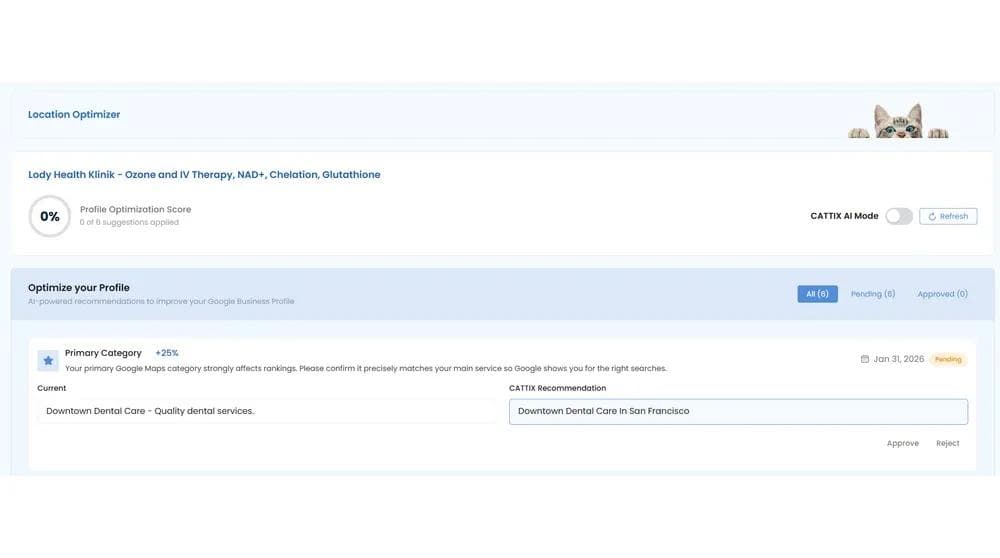
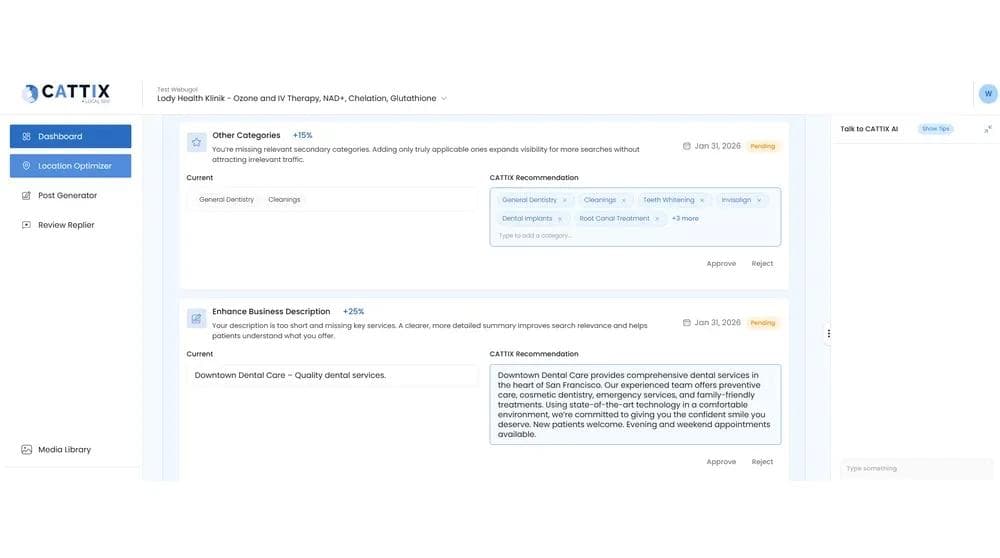
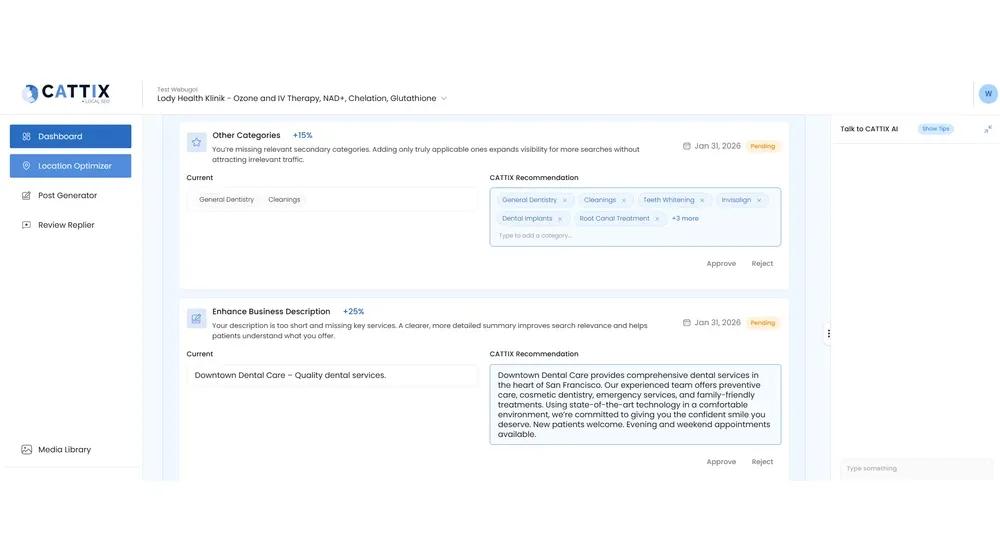
The Location Optimizer delivers the audit depth that makes AI-driven local SEO more effective: every recommendation includes the reasoning behind it - why the change is estimated to improve rankings, what the current state is, and what the recommended state should be. This is the difference between an AI tool that tells you what to do and one that explains why, enabling practitioners to apply judgment rather than blindly following suggestions. For a detailed walkthrough of the audit process, see our guide to the best AI-powered local SEO audit tools in 2026.
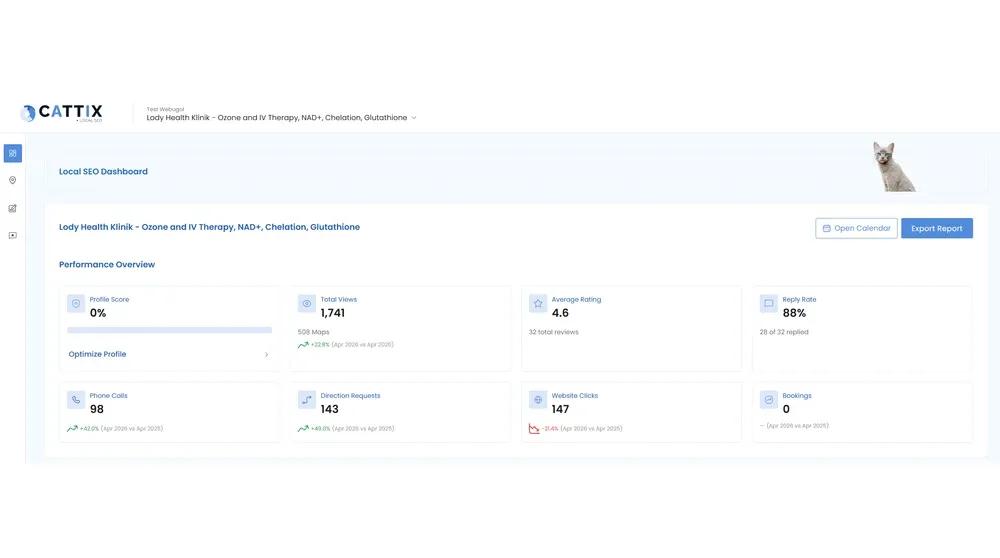
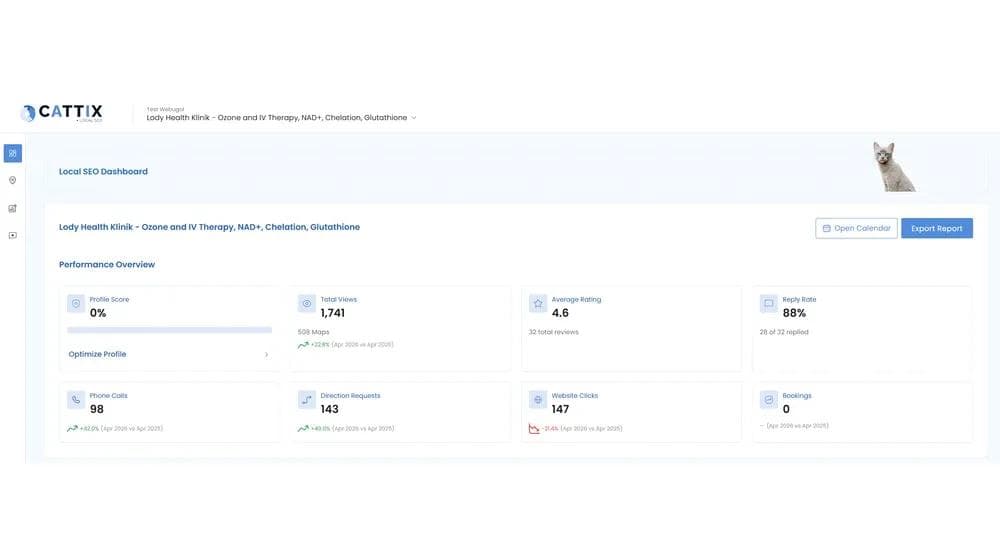
The Local SEO Dashboard closes the loop between AI-driven optimization activity and measurable outcomes - views, calls, ratings, and review reply rate in a single performance overview. Traditional local SEO often lacks this feedback layer: activity is tracked (posts published, reviews responded to) but outcomes are not clearly connected to specific actions. AI-driven local SEO with integrated performance tracking makes the relationship between optimization activity and business results visible and measurable.
For marketing teams managing multiple locations, CATTIX's multi-location support extends all three tools - Location Optimizer, Post Generator, and Review Replier - across every profile simultaneously, with consistent optimization standards applied regardless of location count. This is the scalability advantage that AI local SEO vs traditional local SEO most clearly demonstrates: traditional approaches scale linearly with location count; AI-driven approaches scale with the platform. See how this works in our guide to AI-powered local SEO for marketing teams.
Choosing the Right Approach
The practical guidance on AI-driven local SEO vs traditional local SEO approaches:
- Single location, dedicated time: Traditional local SEO applied consistently by a skilled practitioner can achieve strong results. AI tools add speed and audit depth but are not strictly required.
- Single location, limited time: AI-driven tools are more likely to produce consistent results than manual processes competing with other priorities. The consistency advantage outweighs the setup investment quickly.
- Multiple locations, any team size: AI-driven local SEO is the practical choice. Traditional processes do not scale to multiple locations without proportionally more time - and that time is rarely available consistently.
- Agency managing client locations: AI-driven tools are the only practical option for maintaining optimization standards across a client portfolio. Manual processes at scale produce inconsistent results and are not commercially viable.
Common Mistakes When Switching from Traditional to AI-Driven Local SEO
- Expecting AI to replace strategic thinking: AI tools execute - they do not set strategy. The practitioner still needs to decide which markets to target, which services to prioritize, and how to position the business competitively.
- Enabling full automation before calibrating output: AI Mode produces better results after an initial period of reviewing and approving outputs to calibrate tone, content preferences, and recommendation priorities. Start with approvals enabled.
- Abandoning relationship-based activities: AI handles the execution layer of local SEO but cannot build local backlinks, develop community relationships, or create genuinely local content. These remain manual activities worth maintaining.
- Not connecting activity to outcomes: The performance dashboard is what distinguishes AI-driven local SEO from AI-driven local SEO activity. Track the metrics that show whether optimization work is producing calls, visits, and leads - not just profile completion scores.
Conclusion
The comparison of AI-driven local SEO vs traditional local SEO approaches comes down to consistency and scale. Traditional local SEO works when applied consistently - AI-driven local SEO makes consistency the default rather than the goal. For any business managing more than one location, or where manual local SEO is competing with other priorities, AI-driven approaches produce better results more reliably and with less ongoing effort.
CATTIX delivers AI-driven local SEO across the full workflow - auditing, content, reviews, and performance tracking - in one platform. Start improving your local search results at CATTIX.
About the Author
Eugene Ugolkov, CEO and Founder at CATTIX
Eugene is the founder of CATTIX, an AI-powered Google Ads management platform. With extensive experience in digital marketing and machine learning, he leads the development of intelligent advertising solutions that help businesses maximize their ROI.
Publications: Google Scholar