Best AI-Powered Local SEO Audit Tools in 2026: Find and Fix What's Holding You Back
Most local businesses lose search visibility not because of a strategy problem - but because of gaps they cannot see. An outdated business category, a service missing from the profile, opening hours that do not match actual availability: each one is a small signal degradation that adds up to a significant ranking disadvantage over time.
AI-powered local SEO audit tools identify these gaps automatically, rank them by impact, and generate specific recommendations - replacing the manual profile review process that most businesses either skip or do inconsistently. This guide covers what makes a local SEO audit tool genuinely useful in 2026, how AI is transforming local SEO audits, and what to look for when evaluating options.
Quick Answer
The best AI-powered local SEO audit tools in 2026 analyze your Google Business Profile against optimization benchmarks, identify specific gaps (missing services, incorrect categories, outdated hours, incomplete service areas), rank each finding by its estimated impact on local search rankings, and generate actionable recommendations - rather than producing a generic checklist that applies to every business regardless of their actual profile state.
What Is a Local SEO Audit?
A local SEO audit is a structured review of the signals that influence how a business appears in local search results - primarily Google Maps and the local pack. A complete audit covers:
- Google Business Profile completeness: Categories, services, hours, photos, business description, and service areas
- NAP consistency: Whether name, address, and phone number match across all citations and directories
- Review signals: Volume, recency, response rate, and sentiment across platforms
- On-site local signals: LocalBusiness schema, location keywords, mobile performance
- Local backlink profile: Links from geographically relevant and industry-relevant sources
Most businesses that struggle with local rankings have fixable gaps in one or more of these areas - they just have not identified them. An AI-powered site audit for local SEO surfaces these gaps faster and more consistently than manual review.
Why Traditional Local SEO Audits Fall Short
Manual local SEO audits have three structural weaknesses:
- They are point-in-time: A manual audit reflects the profile state on the day it was conducted. Google Business Profile fields change, competitors add new services, and new profile features are introduced - a quarterly audit misses everything that changes in between.
- They are inconsistent: Manual audits depend on the auditor knowing what to look for. Different auditors apply different standards, and the same auditor applies different levels of attention across different locations or different days.
- They produce generic recommendations: Standard audit checklists apply the same criteria to every business. They tell you to "add photos" without knowing how many you already have, or to "respond to reviews" without knowing your current response rate.
AI-powered site audits for local SEO solve all three problems: they run continuously, apply consistent criteria at scale, and generate recommendations specific to the actual state of your profile.
How AI Is Transforming Local SEO Audits
How AI is transforming local SEO audits comes down to three capabilities that manual processes cannot replicate:
Continuous monitoring instead of periodic snapshots
AI audit tools run in the background, continuously comparing your profile state against optimization benchmarks. When a competitor adds a category you have not claimed, when a new GBP field becomes available, or when your review response rate drops below a threshold - the system flags it immediately rather than waiting for the next scheduled audit.
Impact-ranked Recommendations
Traditional audits produce a list of issues. AI audit tools produce a ranked list where each recommendation comes with an estimated ranking impact - so teams know whether fixing a missing service category is worth more than updating the business description, without having to make that judgment call manually for every finding.
Specificity at Scale
AI can compare your specific profile against competitor profiles, industry benchmarks, and historical performance data simultaneously. The result is recommendations that apply to your situation - not generic best practices that may or may not be relevant to your category, location, or competitive environment. This specificity becomes critical when managing multiple locations, where the audit findings and priorities differ by location.
Key Features of AI-Powered Local SEO Audit Tools
GBP Completeness Scoring
The tool should calculate a profile optimization score that reflects how completely and accurately the profile is filled - not just whether fields exist, but whether the content in those fields meets quality thresholds. A business description that exists but does not mention the business's primary service should score differently from one that does.
Category and Service Gap Detection
Category selection has an outsized impact on which searches a profile appears for. AI audit tools that analyze competitor category usage and flag under-utilized categories specific to your industry provide recommendations that generic checklists cannot. The same applies to services - identifying which competitor services you have not listed, particularly services with measurable search demand, is a specific recommendation that adds real value.
Hours and Contact Accuracy Verification
Inaccurate hours are a trust signal problem as much as a ranking problem. AI tools that flag discrepancies between stated hours and actual operating patterns - or that identify profiles where holiday hours have not been updated - address a gap that manual audits routinely miss because the auditor assumes the hours are correct.
Competitive Gap Analysis
The most useful AI-powered local SEO audit tools benchmark your profile not just against abstract best practices but against the profiles of businesses ranking above you for your target searches. This reveals the specific profile differences that correlate with better local rankings in your market - not in the market generally.
Prioritized Action Queue
Audit output is only useful if it drives action. Tools that generate a prioritized action queue - ordered by estimated ranking impact, with specific implementation guidance - produce more consistent results than tools that produce audit reports that then require further interpretation before action can be taken.
CATTIX Location Optimizer: AI-Powered Local SEO Auditing
CATTIX's Location Optimizer is built around the audit-to-action workflow: identify gaps, rank by impact, and implement recommendations directly from the platform.
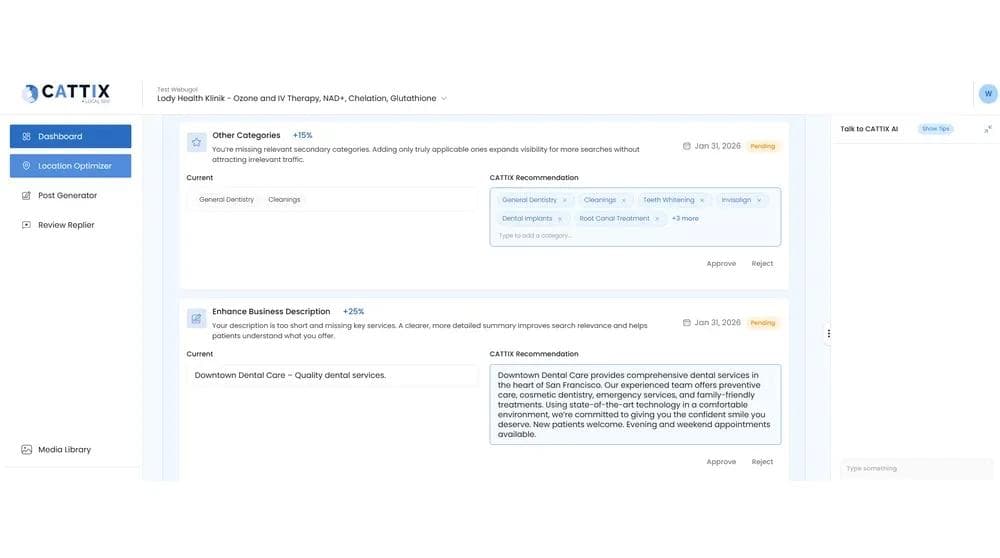
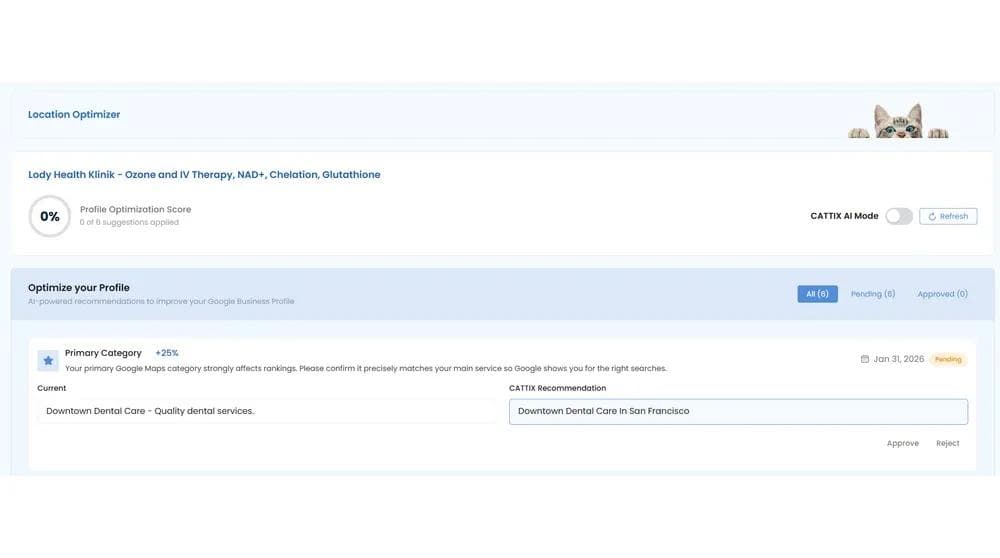
The profile optimization score gives an immediate read on overall GBP health - 0% means significant gaps exist; the recommendation queue below it shows exactly what those gaps are and what addressing each one is estimated to be worth in ranking terms. Each recommendation shows the current state of the profile field, the CATTIX recommendation for what it should be, and the estimated percentage improvement in local search visibility from making that change.
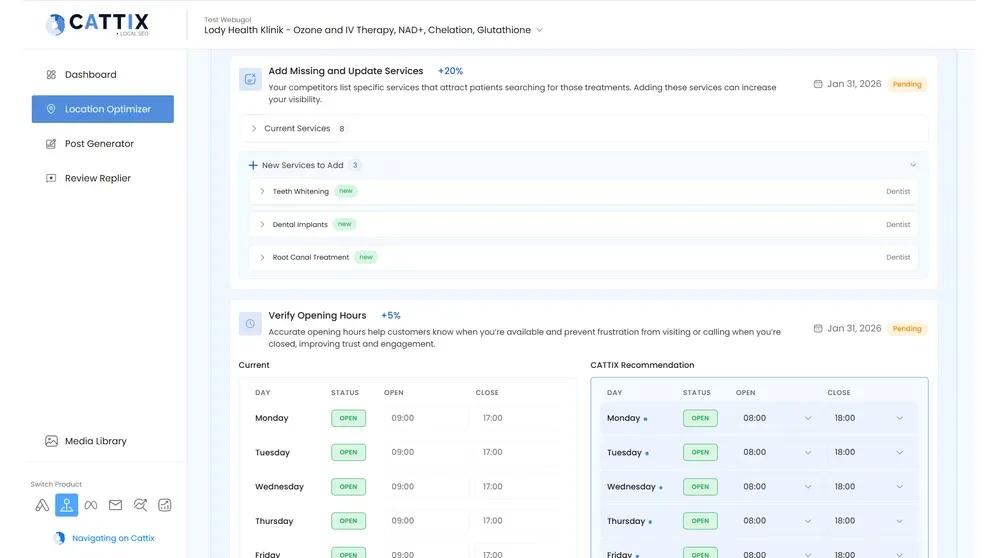
The service gap detection is particularly useful for businesses in competitive categories. CATTIX identifies services that competitors in your category are listing that you are not - with the specific service names and an estimate of the visibility impact from adding them. This is the kind of AI-powered site audit for local SEO finding that manual audits miss entirely, because it requires comparing your profile against competitor profiles systematically rather than reviewing it in isolation.
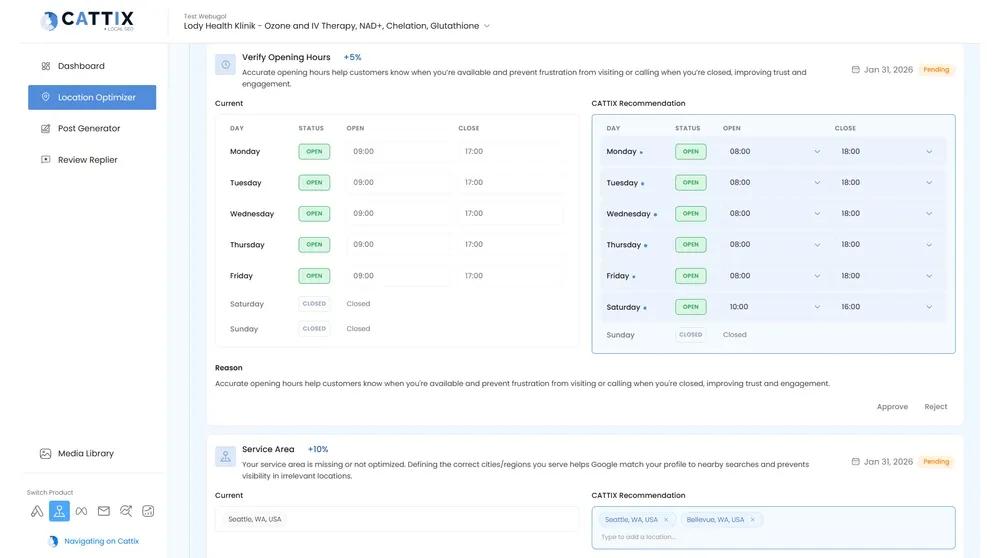
Hours accuracy verification compares your stated hours against patterns CATTIX identifies, and service area recommendations flag when the cities and regions you serve are not reflected in your profile - a gap that prevents Google from showing your listing for searches in areas you actually serve. Both recommendations include a current vs. recommended comparison so the change required is immediately clear.
With CATTIX AI Mode enabled, approved recommendations are applied automatically - closing the gap between audit findings and implementation that slows most local SEO programs. For teams managing multiple locations, the same audit logic runs across every profile simultaneously, surfacing the highest-impact gaps across the entire location portfolio rather than one profile at a time.
To see how the audit workflow fits into a broader local SEO program, see our guides on how to improve local SEO in 2026 and AI-powered local SEO for marketing teams.
What to Look for When Evaluating AI Local SEO Audit Tools
- Does it audit continuously or on demand? Continuous auditing catches issues as they emerge. On-demand tools are only as useful as the frequency with which you run them.
- Are recommendations ranked by impact? A list of issues with no prioritization puts the burden of judgment back on the user. Impact-ranked queues tell you where to start.
- Does it include competitor benchmarking? Recommendations grounded in what competitors in your specific category and location are doing are more actionable than recommendations derived from generic best practices.
- Can it act on findings directly? The gap between audit report and implementation is where most audit value is lost. Tools that can apply recommendations directly - or integrate with platforms that can - produce faster results than tools that require a separate implementation step.
- Does it scale to multiple locations? If you manage more than one location, the tool needs to audit all of them consistently and surface cross-location comparisons - not just run one profile at a time.
Common Mistakes in Local SEO Auditing
- Auditing only the GBP in isolation: A complete local SEO audit covers GBP, citations, on-site signals, and review data together. Auditing only the GBP misses compounding issues where, for example, NAP inconsistencies in citations are undermining an otherwise well-optimized profile.
- Acting on all findings simultaneously: Addressing every audit finding at once without prioritizing by impact dilutes effort and makes it harder to attribute improvements to specific changes. Start with the highest-impact recommendations and work down.
- Not re-auditing after implementation: Audit findings that have been addressed should be re-verified. Implementation errors, platform delays, or partial updates can mean a finding appears resolved when it is not.
- Using the same audit criteria for every business type: The relevant benchmarks for a dental practice differ from those for a restaurant or a law firm. AI audit tools that apply category-specific criteria produce more relevant findings than tools that apply a single universal checklist.
- Treating the audit as a one-time project: Local SEO audit value comes from continuous monitoring, not a single review. Businesses that run audits once and consider the work done will see their optimization degrade as competitors improve and new profile features are introduced.
Conclusion
The best AI-powered local SEO audit tools in 2026 do more than identify what is missing - they rank findings by impact, benchmark against competitors, and connect audit results to implementation without requiring a separate workflow. How AI is transforming local SEO audits is most visible in this last point: the time between identifying a gap and fixing it has collapsed from days to minutes for teams using AI-powered site audits for local SEO with direct implementation capability.
CATTIX's Location Optimizer covers the full audit-to-action cycle - profile scoring, gap detection, impact ranking, and direct implementation - in one platform. Start auditing your local SEO at CATTIX.
About the Author
Eugene Ugolkov, CEO and Founder at CATTIX
Eugene is the founder of CATTIX, an AI-powered Google Ads management platform. With extensive experience in digital marketing and machine learning, he leads the development of intelligent advertising solutions that help businesses maximize their ROI.
Publications: Google Scholar