
AI Prompts for Google Ads: Write Better Ads in Half the Time
Writing Google Ads copy is deceptively hard. Each headline is limited to 30 characters. Each description gets 90. Within those constraints, you need to match search intent, lead with a clear benefit, differentiate from competitors, and include a call to action - all before the user decides to scroll past. Doing this well across dozens of ad groups takes time most teams do not have.
AI prompts for Google Ads change the speed equation without removing the human judgment that makes copy actually convert. A well-structured prompt gives an AI model the context it needs to generate relevant, on-brand headline options in seconds - options you evaluate, refine, and approve rather than write from scratch.
This guide covers what makes a Google Ads AI prompt effective, eight ready-to-use prompts you can apply today, and how CATTIX's Ad Improver automates the analysis layer so you know which copy needs improvement before you write a single new line.
Quick Answer: What Are AI Prompts for Google Ads?
An AI prompt for Google Ads is a structured instruction that gives an AI model the context needed to generate relevant ad headlines, descriptions, or complete responsive search ads. Effective prompts specify the product, target audience, primary benefit, character limits, tone, and any keywords to include. The output is a starting point for human review - not a finished ad.
What Makes a Strong Google Ads AI Prompt
Generic prompts produce generic output. "Write a Google Ad for my software company" will return something technically correct and completely unusable. Strong ai prompts for google ads share five components:
- Product clarity: What exactly are you advertising? Be specific - "AI-powered Google Ads management platform" performs better than "software."
- Audience definition: Who is searching? "Small business owners running their first Google Ads campaign" generates very different copy than "PPC agency managers with 50+ client accounts."
- Benefit focus: What outcome does the customer get? Lead with the result, not the feature.
- Constraints: Character limits (30 for headlines, 90 for descriptions), keyword requirements, tone guidelines.
- Context: What makes your offer different from competitors? The more specific, the better the output.
With these five elements in place, AI-generated Google Ads copy becomes a usable first draft rather than a starting-point-for-deletion.
8 AI Prompts for Google Ads You Can Use Today
Prompt 1 - RSA Headlines from Scratch
Write 10 Google Ads responsive search ad headlines for [product/service]. Each headline must be under 30 characters. Lead with the primary benefit: [benefit]. Target audience: [description]. Include at least 2 headlines containing the exact keyword: [keyword].
Prompt 2 - Descriptions with a CTA
Write 4 Google Ads descriptions (max 90 characters each) for [product]. Highlight [USP 1] and [USP 2]. End each description with the call to action: [CTA]. Avoid superlatives like "best" or "leading."
Prompt 3 - Message Match to Landing Page
My landing page headline is: [headline]. My main value proposition is: [claim]. Write 5 Google Ads headlines that create strong message match with this page. Max 30 characters each.
Prompt 4 - Benefit-Led Copy from Pain Points
My product is [product]. My customers' main problem is [pain point]. Write 8 headlines that lead with the specific outcome the customer achieves - not product features. Max 30 characters each.
Prompt 5 - Competitive Differentiation
My key differentiator versus competitors is [differentiator]. Write 6 Google Ads headlines that position this advantage without naming competitors directly. Max 30 characters each.
Prompt 6 - Rewrite Underperforming Headlines
These are my current Google Ads headlines: [list]. Average CTR is [X%], below my target of [Y%]. Rewrite each headline to increase click-through rate. Keep the same keyword focus but lead with a stronger benefit or create more urgency.
Prompt 7 - Audience-Specific Copy
Write 8 Google Ads headlines for [product] specifically targeting [audience, e.g., "e-commerce store owners scaling to revenue"]. Use pain points and language specific to this audience. Max 30 characters each.
Prompt 8 - Social Proof in Descriptions
Write 3 Google Ads descriptions (max 90 characters) incorporating social proof. We have [X customers], [Y-star average rating], and [Z years in business]. Include one clear CTA in each.
CATTIX Ad Improver - Beyond Generic Prompts
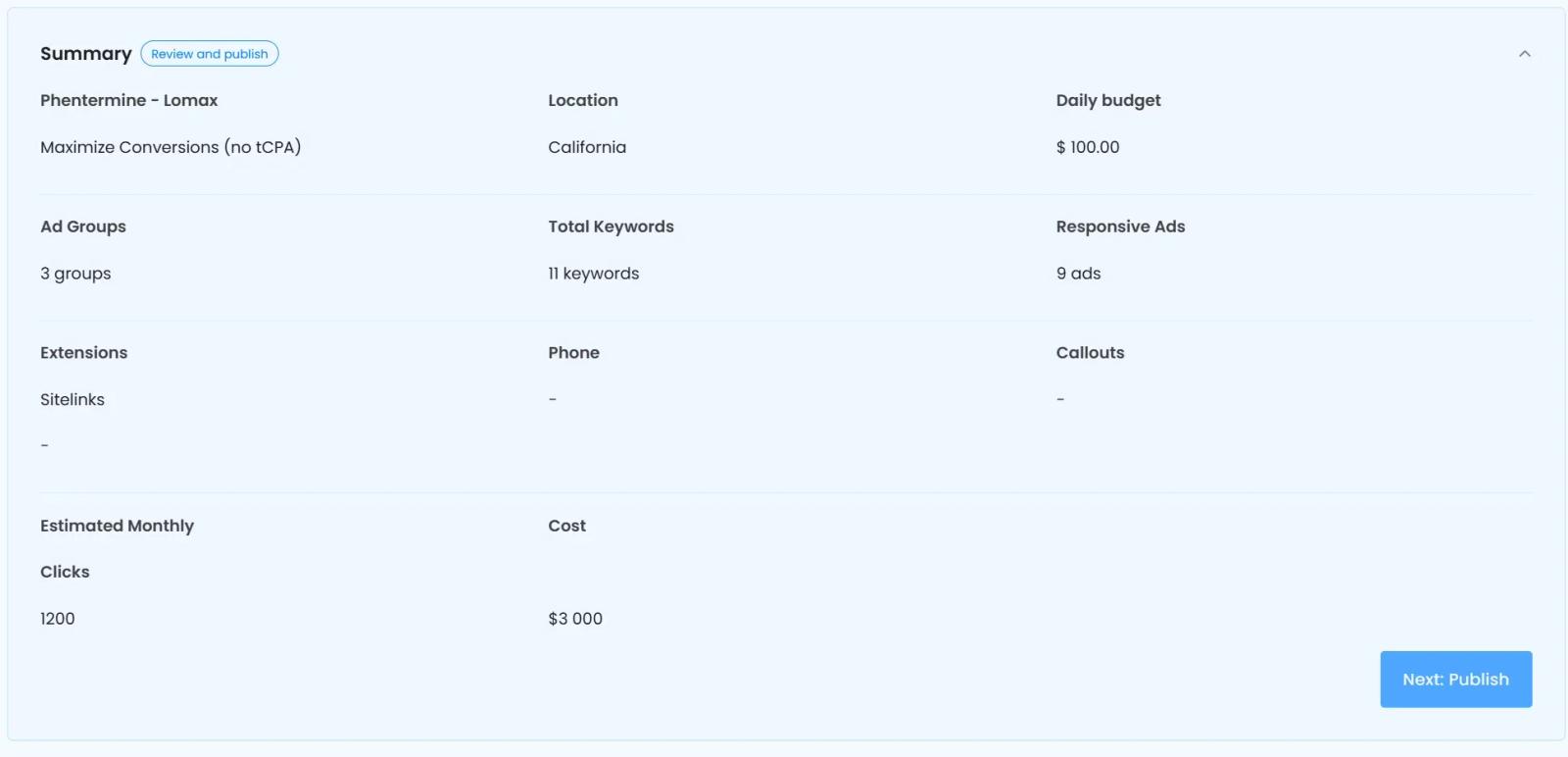
The prompts above assume you know which ads need improvement. In a large account with dozens of ad groups, identifying the specific headlines with low CTR, poor Quality Score, or weak message match is itself a time-consuming task.
CATTIX's Ad Improver handles this analysis layer automatically. It scans your live ad copy across all campaigns, benchmarks each ad against competitor messaging and performance signals, and surfaces the specific headlines and descriptions that are dragging results. Rather than writing new copy blindly, you start from a prioritized list of what to fix and why.
When you combine targeted ai prompts for google ads with CATTIX's ad-level analysis - knowing exactly which ad groups need new copy before you write a word - the time saving compounds. You are not just writing faster; you are writing where it matters most. This is what separates ad-level AI analysis from using ai for google ads approaches that treat every ad group the same regardless of performance data.
For teams evaluating top ai tools for google ads that cover both copywriting and broader campaign management, CATTIX's integrated approach means the Ad Improver's recommendations feed directly into the same platform handling keyword analysis, search term cleanup, and market research.
How to Refine AI-Generated Ad Copy
AI output is a draft, not a final product. After generating headlines and descriptions, apply this review checklist:
- Check character counts - AI models frequently exceed the 30/90 character limits. Always verify before uploading.
- Read for brand voice - AI defaults to generic professional tone. Adjust word choices that feel off-brand.
- Verify keyword inclusion - Confirm your primary keyword appears in at least 2-3 headlines for Quality Score purposes.
- Test the CTA - Weak calls to action ("Learn More," "Click Here") rarely outperform specific ones ("Start Free Trial," "Get Instant Quote").
- Check for superlatives - Google flags exaggerated claims. Replace "best," "fastest," and "#1" with specific, provable statements.
Common Mistakes When Using AI Prompts for Google Ads
- Underprompting: Providing no audience, benefit, or keyword context produces useless generic output. Always include all five prompt components.
- Publishing without review: AI-generated ad copy can include inaccuracies, wrong character counts, or claims that violate Google's advertising policies. Always review before uploading.
- Using one prompt for all ad groups: Each ad group targets a different intent. Rewrite your prompt for each ad group's specific keyword theme rather than reusing a single output across campaigns.
- Ignoring performance data: Writing new copy without knowing which existing ads underperform wastes effort. Use account analysis tools to identify priority ad groups before prompting.
Conclusion
AI prompts for Google Ads compress hours of copywriting into minutes - but only when the prompts are specific enough to produce usable output. The eight prompts above give you a proven framework for RSA headlines, descriptions, message match, and competitive positioning.
For teams that want to combine smart prompting with data-driven analysis of which copy actually needs improvement, CATTIX brings the Ad Improver and full campaign management suite together in one platform - so you spend less time guessing and more time acting on what the data shows.
About the Author
Eugene Ugolkov, CEO and Founder at CATTIX
Eugene is the founder of CATTIX, an AI-powered Google Ads management platform. With extensive experience in digital marketing and machine learning, he leads the development of intelligent advertising solutions that help businesses maximize their ROI.
Publications: Google Scholar